Acupressure mat for the lower back: how to use it
Your back is one of the areas we ourselves suggest starting with, and one that may need a little more time. A Shakti mat is not a treatment and does not replace medical care. What it does physically is simple: thousands of sharp spikes rest against your skin, your body weight is spread across all the points of contact instead of gathering in one place, and the redness left on your skin is a sign of increased circulation. Here we go through how you actually reach your lower back with an acupressure mat, which level you can start on, what the Back Wrap is for, and when you shouldn't use the mat at all.
What do the spikes actually do to your back?
The Shakti mat works through direct contact. When you place the mat against your body, the spikes gently press against your skin, and your weight is spread across all the points of contact instead of gathering in one place. The spikes are made of recyclable medical-grade ABS plastic, and the cover is GOTS-certified organic cotton.
Does it hurt? Yes, but only a little at first. Each spike responds to tension in your body, so the more tension you carry in an area, the more clearly you feel it. After a few minutes the tingling usually turns into a deep, relaxing warmth, and the redness left on your skin is simply a sign of increased circulation. It's completely normal to fall asleep on the mat.
What we don't say: that the mat treats back problems. It doesn't. What we describe is the pressure, the warmth and the moment of stillness.
How do you actually reach your lower back with an acupressure mat?
Reaching the lower back is mostly about the surface you lie on and where you place the mat. A few things make a difference.
Start on a softer surface. You can use your mat wherever you like – in bed, on the floor, in a chair or on the sofa – but softer surfaces provide a bit of extra support and can be a good place to start. Lie down slowly to distribute your weight evenly, take a deep breath and exhale.
The mat doesn't need to cover your entire back to give you a good session. You can move it down so that it sits right under your lower back.
Plan for around 20 minutes – that's the average time to find what we call Shakti bliss. We recommend 15–20 minutes to experience the full benefits of the acupressure, and while some areas only need a few minutes, your back may need a bit longer. There are no time or frequency restrictions for a session.
Bare skin gives the best results, but during your first few sessions you can wear a thin t-shirt or place a pillowcase over the mat while your body adjusts.
Which level should you choose?
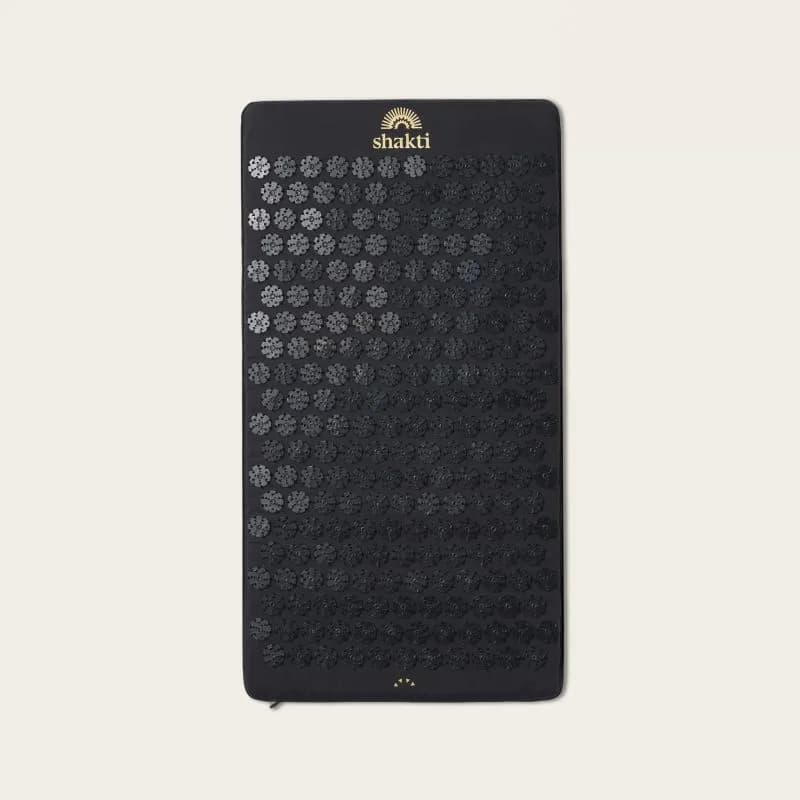
The levels differ in the number of spikes, and it works the opposite way to what you might expect: fewer spikes give a more intense effect, because your body weight is spread over fewer points. Every level has 230 discs – it's the number of spikes per disc that varies.
Level 1 Light has 8,280 spikes and is perfect to start with. Level 2 Original has 6,210 and is the most popular. Level 3 Advanced has 4,140 and is for experienced users. Level 4 Ultra has 2,070 and gives the most direct stimulation.
If you've never lain on spikes before: go low. Go too hard at the start and it's harder to build a lasting habit. The Shakti Classic Acupressure Mat comes in two levels: Level 2 with 6,210 spikes – a medium intensity that, according to our product description, suits around 95% of users – and Level 3 with 4,140 spikes. The Shakti Premium Acupressure Mat comes in all four levels and measures 74 × 40 × 2.5 cm.
Not sure? Our Find Your Level guide asks four quick questions and gives you one clear answer. And if the level feels wrong once the mat is at home, you can exchange it for a different level within 30 days, as long as the product is in the same condition as when you received it. The exchange applies to purchases made directly on shaktimattan.se, and we offer one exchange per order.
How does the Back Wrap work if you can't lie down?
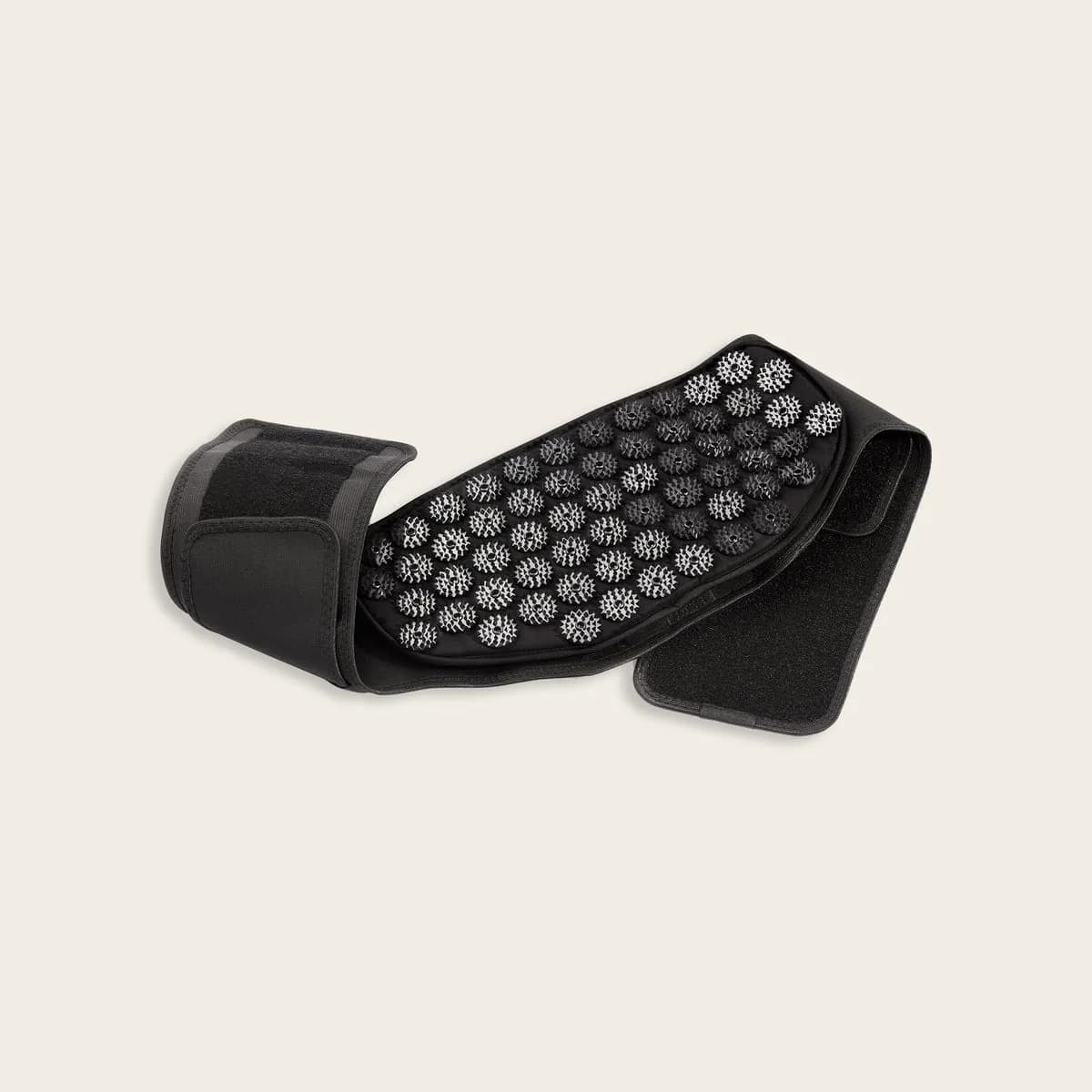
Not everyone has 20 minutes to lie down in the middle of the day. The Shakti Back Wrap is a belt you place around your waist, with a movable acupressure pad with 2,196 spikes in medical-grade ABS plastic. Place the spikes at the back for the lower back and fasten the inner straps so everything sits securely, then fine-tune the pressure by pulling the outer straps forward. One strap holds the belt steady against your body; another controls the spikes' pressure.
Wear the belt for 15–30 minutes while sitting, walking or doing lighter activities. Expect a distinct, focused pressure against the lower back. The spikes stimulate circulation and activate acupressure points, which often produces a tingling, warming and deeply relaxing sensation after just a few minutes. Without the pad, the belt works as steady support throughout the day.
The belt measures 110 × 20.5 cm and weighs 0.41 kg. We stock it in size Medium, which fits a waist measurement of 80–99 cm. Measure with a soft measuring tape at your navel – trouser sizes don't reflect your true waist measurement. A tip from the product page: if you're going to sit with the belt on, put it on while seated.
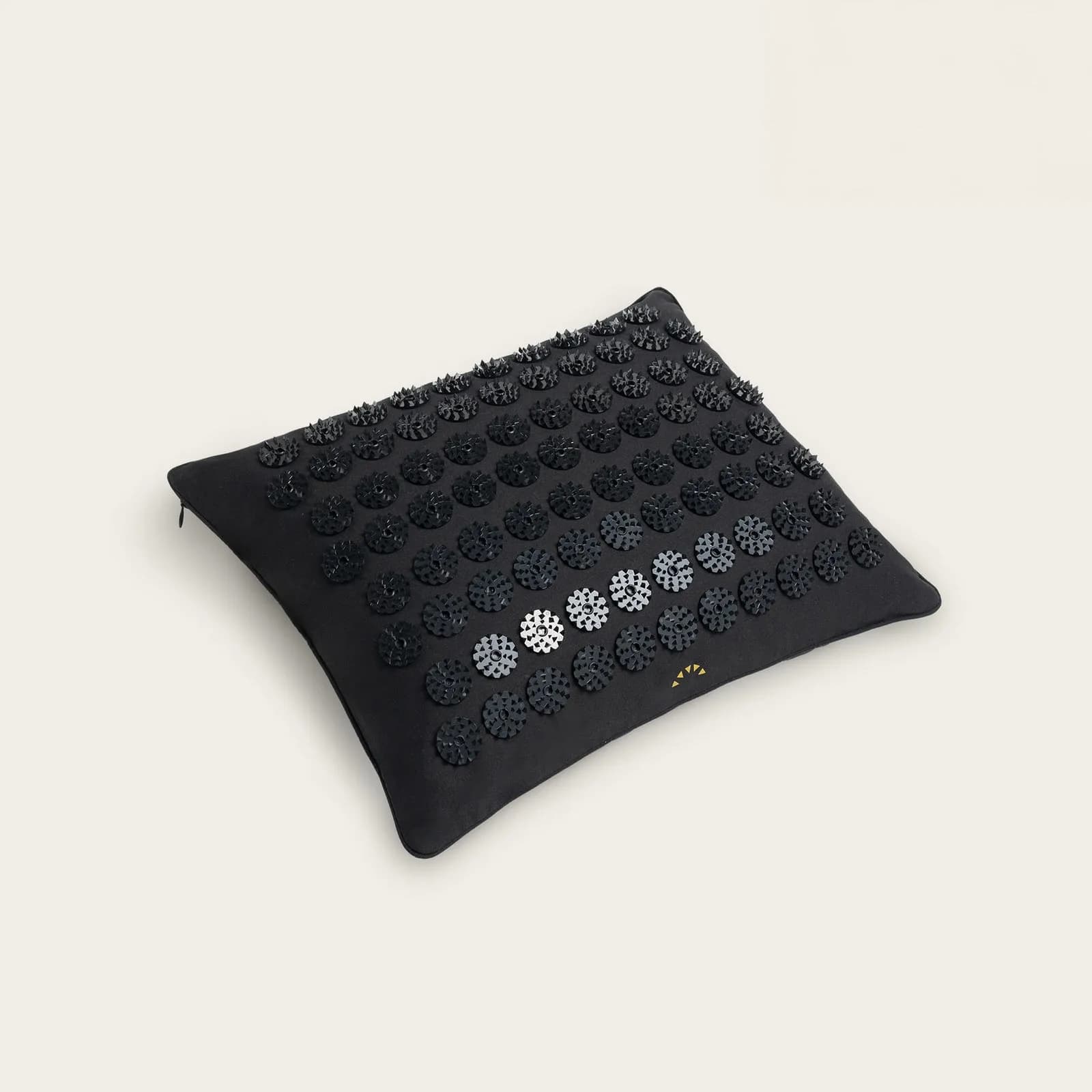
If you'd rather sit than lie down, there's one more option: the Shakti Premium Acupressure Pillow can be placed against your lower back while you sit and relax.
When should you not use an acupressure mat?
Back pain isn't one thing, and we don't comment on individual diagnoses. We don't know what the mat does for sciatica or lumbago, and we're not going to guess for you. What we can tell you is what our own FAQ says about when the product shouldn't be used at all.
“Do not use the Shakti mat or its accessories if you have any of the following conditions:”
Coagulation problems or if you're taking blood-thinning medication. The Shakti mat can affect circulation and is therefore not recommended for people with circulation-related and/or blood coagulation problems.
Epilepsy – The Shakti mat is covered with thousands of sharp spikes and could be dangerous if a person has a seizure whilst using it.
Significant skin damage in the area where you intend to use the mat, including pronounced skin inflammation or large papillomas. Certain skin conditions may be worsened by the mat.
Neuropathy with loss of sensation or reduced sensation, as this can affect your ability to feel the sharpness of the spikes.
Pregnancy – Certain acupressure points are sometimes used to naturally induce labour.
Cardiovascular conditions – The Shakti mat can affect circulation and is therefore not recommended for people with heart and circulatory problems.
Thrombophlebitis – see coagulation problems and cardiovascular conditions above.
Fever or other acute illness.
Pregnancy is on the list for a reason. Unfortunately, we don't recommend pregnant women use the Shakti mat, particularly during the first trimester. The Shakti mat uses acupressure, which in some cases has been used to naturally induce labour. Always consult your doctor before using the mat.
The same goes for the Back Wrap: We do not recommend acupressure tools during pregnancy or immediately after giving birth. Without the spike pad, however, the belt works as a classic lower-back belt and can be used throughout pregnancy.
Always consult your doctor about use with or without the spike pad during pregnancy and the postpartum period.
If you have any other medical condition or illness, we recommend you consult your doctor before using the product. If you are pregnant, or planning to become pregnant, consult your doctor before use.
Products mentioned in the guide
More guides
- Best acupressure mat: how to choose the level, size and modelNo acupressure mat suits everyone. How to choose the right level, size and model – and the difference between Shakti Premium and Classic, plainly.
- How long should you lie on an acupressure mat – and how often?We recommend 15–20 minutes on an acupressure mat, with 20 minutes as the benchmark – and there are no frequency limits. Here's how long and how often.
- Acupressure mat benefits: how it feels and who it suitsAn acupressure mat presses thousands of spikes against your skin. Here's what it does, what it's used for, who it suits – and who should avoid it.